

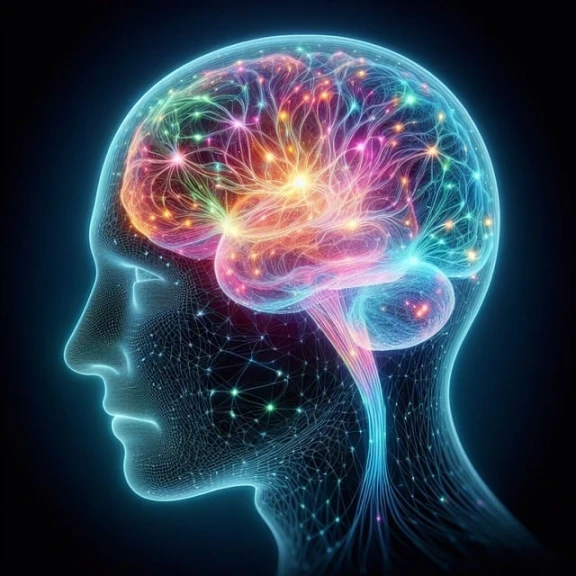
Before machines could learn to think, humans first had to explore a deeper question — what does it actually mean to think? Artificial Intelligence began with curiosity about the human mind: how do we learn? Remember? And how do we make decisions in a world full of uncertainty? From the silent firing of neurons in the brain to the structured logic of early mathematics, AI's journey is less about machines replacing humans and more about humans trying to understand themselves—and, in doing so, building something that can echo that intelligence in silicon.
At its core, AI is a branch of computing that enables machines to do something we once thought only humans could do. But to understand how machines learned to think, we first need to understand how we think.
Understanding Human Intelligence.
Human Intelligence is a mental process that enables the brain to reason, learn, and solve problems. Intelligence also integrates mental functions such as perception, attention, and memory. Different parts of the brain support various activities. For example, the amygdala creates a sensation of fear, the hippocampus encodes memories, and the prefrontal cortex supports human function and behavior.
However, intelligence emerges through a network of billions of neurons across several parts of the brain. Imagine sitting at a busy restaurant, and someone calls out your name. The sound enters your ears and is converted into electrical signals. Neurons communicate these signals to other neurons, sending the information deeper into your brain. Some parts of the brain identify the speech, others the pattern of your name, while others connect it to the memory of your name. When the signals reach a particular threshold, the neuron fires an impulse, and you turn your head to locate the person who called out.
Neurons begin forming as we develop in the womb, where each neuron connects to thousands of others to form a complex communication network. Neurons are information messengers that use signals to send information between different areas of the brain and the rest of the body. When a neuron receives incoming signals, they add up until they reach a particular threshold. Once they exceed the threshold, the neuron is triggered to send an outgoing impulse.
How AI Copies This
Artificial Intelligence mirrors this process through four building blocks:
1. Machine learning gives machines the ability to learn from data rather than follow rigid instructions — the more data, the smarter it gets.
2. Large data sets are the reference material. Think of them as the years of experience a human draws from when making a judgment call.
3. Natural Language Processing (NLP) enables machines to understand and respond in human language — it's why Siri understands you when you say "remind me to call dad tonight" rather than needing you to type a command.
4. Neural networks are the closest AI gets to replicating the brain. Built from millions of artificial neurons arranged in connected layers, they process information the same way biological neurons do — passing signals forward once a threshold is crossed, learning and improving with every cycle.
The more data these networks are trained on, the more accurately they reason and solve problems. However, AI systems still have limitations and can misunderstand context.

Where the Idea Was Born
The story of AI begins earlier than most people realize.
In 1936, English mathematician Alan Turing published On Computable Numbers — a theoretical paper describing an imaginary machine capable of executing any mathematical instruction. It was the first time anyone had formally described what a computer could be. We now call it the Turing Machine.

Did McCulloch and Pitts ever imagine their published paper would one day power Amazon's Alexa, Google Maps, or OpenAI's GPT?


From a mathematical theory sketched in a quiet journal to technology that now shapes how billions of people navigate, communicate, and work — the distance between those two points is extraordinary.
What Comes Next
We now know what AI is and where the idea came from. But knowing the blueprint is one thing — watching it actually get built is another story entirely.
In Part 2, we follow the decades of breakthroughs, setbacks, and unexpected moments that turned a theory discussed in a university conference room into the technology now sitting in your pocket, running your maps, and writing your emails.
How much do you think it took humanity to get there? As you follow this story, remember: the evolution of AI isn't just history—it is reshaping jobs, education, and even your daily routines right now.